I. The Arrest
I sigh as the message on the call bleep blares out in unison across the doctor’s mess; “Cardiac Arrest, Older Persons Assessment Unit”. It’s my turn on call today and so I drag myself up and wander down to the ward. Already at this point, I have a degree of cognitive bias for what is waiting for me. Surely there shouldn’t be anyone for active resuscitation in our frailty unit. Has someone not found the DNACPR form in a set of notes? Did Mrs Jones have another vasovagal when the physiotherapists moved her into the chair? “It would be the third one this week… maybe I should look at her medication again…” I muse as I walk down the corridor.
It isn’t Mrs Jones. I am greeted by the sight of a small crowd of nurses and two junior doctors around another patient’s bed. The charge nurse is doing chest compressions. Right. It’s a real one then. I position myself at the end of the bed and ask someone to tell me what the story is.
Mrs Eileen Davies* is an 84 year old woman who we’ve been treating for decompensated heart failure and pneumonia. Although the antibiotics seemed to have helped with the infection, her heart isn’t pumping well enough and as a result, fluid has accumulated in her legs and on her lungs. An echocardiogram performed the day after she was admitted revealed an ejection fraction of 20% and severe pulmonary hypertension. She’s relatively frail; by definition, all patients on the unit are. In this context, Mrs Davies has stopped being able to manage some of her activities of daily living; she can’t do the shopping or cooking anymore and she walks with a wheeled walker and suffers with breathlessness on exertion.
My immediate thought to the story is “well this is fucking futile” as I watch nurses switch out to continue chest compressions. “Can we pause for a rhythm check?” I ask, just as the team from intensive care arrive. They position themselves at the top of the bed and start taking over the airway. I glance at the monitor. “No pulse” someone calls out. The wavy lines look uncontrolled and messy. “Ventricular fibrillation… let’s get ready to shock”. We pause and all move away from the bed, and before I press the button I make sure no one else is touching the patient. “Clear”. Eileen jolts a little in the bed. “Back on the chest”.
In my head, I’m thinking about how long we should go on before I call it and make sure everyone agrees. But then on the next pulse check, unbelievably, there is a pulse.
For a moment the room exhales, and there is that satisfying blip on the monitor, and I have been trained to feel this as success. But Mrs Davies is agonal breathing with her oxygen saturations hovering in the seventies despite high-flow oxygen. I look at the ICU registrar and ask “will you take her?” even though I already know the answer. Of course they wont. They shrug and phone the consultant. He appears a few moments later and glances at Eileen at the bed then raises his eyebrow at me incredulously. He spends the couple of minutes flicking through her most recent scans on the computer next to the bedside and pauses on the echocardiogram report.
“Ejection fraction of twenty percent and those pulmonary pressures? Yeah, thanks but no thanks, write her up for some midazolam.” He wanders off to document something at the nurses station. To the outsider this laissez-faire attitude to death might seem cold. But its a defense mechanism of sorts. As a doctor, you have to detach yourself from the emotion whilst you’re making the call on how long you’ll keep someone alive for. Absorbing the true amount of misery and sadness we see every day would be too much of a burden otherwise.
I don’t blame him because he’s right, and by every metric we use, by every algorithm and scoring system and guideline, he is objectively and defensibly correct. Mrs Davies is not a candidate for intensive care. The decision is made, and I write it in the notes, and I prescribe the midazolam and morphine, and I do what I have been trained to do.
II. The Husband
Her husband Gwyn is already in the hospital and had just gone for a coffee with his children. Someone finds him and brings him to the ward, and I take him to the relatives’ room. I’ve done this more times than I can count; I know the script. I tell him that Eileen’s heart stopped, that we did everything we could, that we got it beating again but she’s very unwell, that her heart and lungs are too damaged to recover, and that the kindest thing now is to keep her comfortable.
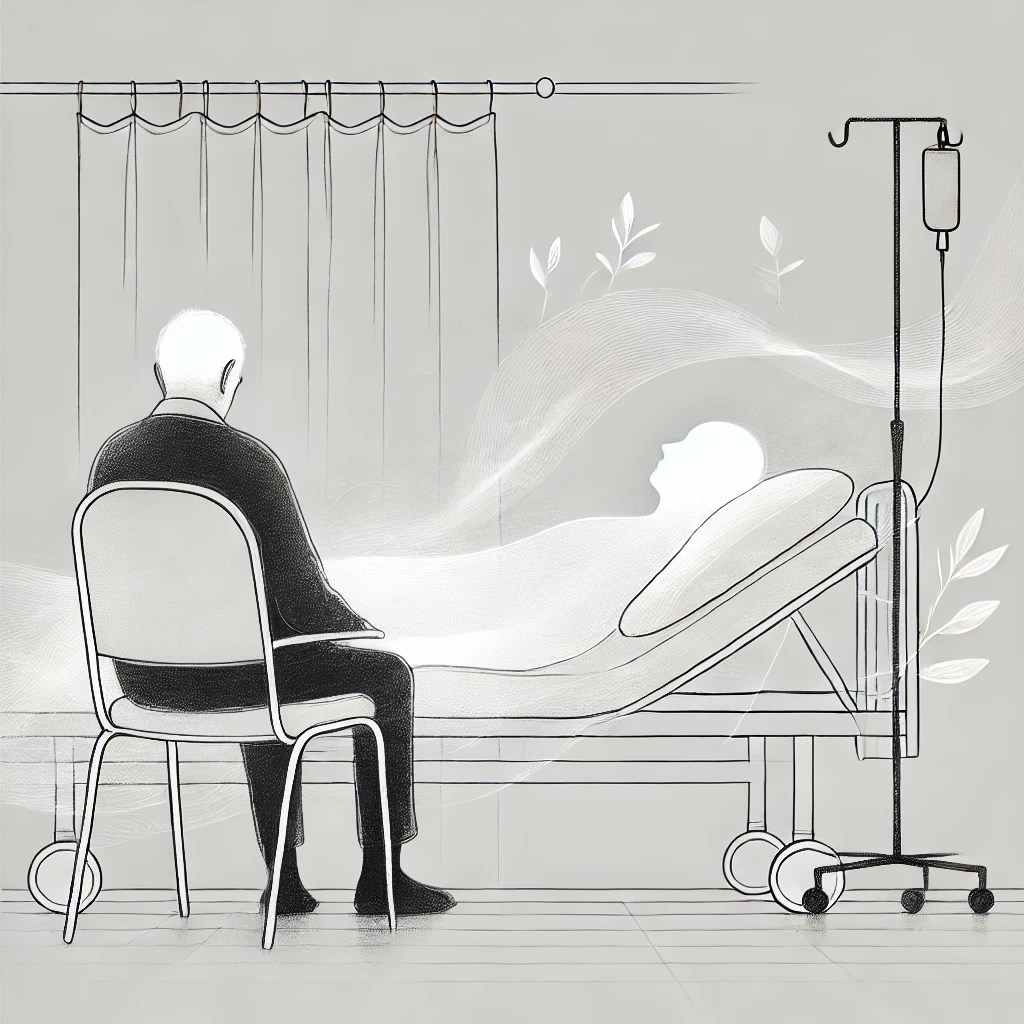
He nods but doesn’t cry, and asks if he can sit with her.
I say of course, and I mean to leave because there’s a jobs list waiting and a ward round I’ve abandoned and referrals piling up somewhere, but he asks me to sit as well, and I don’t refuse.
He starts talking. They met in 1961 at a dance in Pontypridd, he tells me. He was a mining engineer and she was a secretary at the colliery. He tells me about their wedding, how it rained and her mother cried and he was so nervous he put the ring on the wrong hand. He tells me about the moves: Durham first, then Kent, then Scotland when the pits closed. Always following the work. She never complained, he says. Just packed up the house every time and made a new home wherever they landed. She was the strong one. He always thought he’d go first because of his heart. He had a heart attack a few years back, then a coronary bypass. It should have been him.
I listen and I don’t check my bleep.
The light through the window shifts as the afternoon wears on, and Eileen’s breathing changes, getting slower and quieter as the morphine does its work. Gwyn holds her hand through all of it. When she dies he thanks me.
“You were kind,” he says. “You listened.”
And then, almost to himself: “This will be the end of me now.”
I don’t know what to say to that.
III. The Question
I think about Eileen a lot in the weeks that follow, though not really about her death. Death is part of the job and I’ve made my peace with that, mostly. What I can’t stop thinking about is the sequence of decisions that got us there.
We shocked a woman with end-stage heart failure whose frailty score should have prompted a proper conversation about ceilings of care long before she arrested. We got ROSC, which felt like success for about thirty seconds, and then immediately decided she wasn’t a candidate for the only thing that might have kept that success going. We brought her back and then we let her go. We put her through all of that so she could die a few hours later with her husband watching.
I keep asking myself if that was the right thing to do. I genuinely don’t know.
The obvious answer is that we didn’t have a choice. No DNACPR means we’re legally obliged to attempt resuscitation, and the default is always to treat. That’s the framework and it protects us. But it doesn’t quite satisfy me, because somewhere in the chain of events leading up to that afternoon there were loads of smaller decisions that no one really examined. The decision not to have the difficult conversation when she was admitted. The decision to write “not for ITU, for full active treatment otherwise” as though that’s a coherent plan rather than a contradiction waiting to happen. The decision to treat her frailty score as a number in a box rather than a prompt to actually talk to her and Gwyn about what they wanted.
And then afterwards, the decision that she was too frail for intensive care but apparently hadn’t been too frail to shock. I’m frustated at the fact that no one had attempted the conversation until it was too late.
IV. The Scale
The Clinical Frailty Scale was designed by Kenneth Rockwood in 2005, and the idea behind it was sensible enough. Geriatricians have always known that two 84-year-olds can be completely different in terms of their reserve and their resilience and their ability to bounce back from being unwell. The CFS was meant to capture that, to give us a shared language for something we could all see but struggled to articulate. It was validated for prognostication. It was never meant to be a rationing tool.
Then COVID happened, and suddenly it became one.
In March 2020, NICE put out rapid guidance saying the CFS should be used to inform decisions about ITU admission. A score of 5 or more should trigger a conversation with critical care about whether escalation was appropriate. The guidance said all the right things about holistic assessment and clinical judgement, but in practice what happened was that the CFS became a gatekeeper. A number that decided who got the ventilator and who got the syringe driver. A tool for describing people became a tool for sorting them.
The disability community spotted the problem straight away. The CFS was only validated in over-65s, and it confuses frailty with disability. These are not the same thing. Someone with cerebral palsy who uses a wheelchair might score 7 because they need help with personal care, but they could have completely normal physiological reserve and an excellent chance of surviving critical illness. The scale measures how much help you need, not how sick you are or how likely you are to recover. In a society that’s a bit obsessed with independence, that’s not a neutral distinction.
I did my master’s in medical anthropology before medicine, and I remember reading Sharon Kaufman’s work on how frailty gets constructed in healthcare encounters. Her argument is that frailty isn’t just a biological state we discover in patients; it’s a category we create through the assessments we do and the questions we ask and the assumptions we bring. When I give someone a CFS score, I’m not measuring something that exists independently of me. I’m participating in a process that makes frailty real and gives it administrative power.
Eileen was a 6. Moderately frail. Needs help with outside activities and housework, has problems with stairs, needs help with bathing. That’s what the scale tells me. It doesn’t tell me anything about sixty years of marriage, or following the work across four countries, or being the strong one, or what any of this meant to her and to Gwyn.
I’m not saying we should stop using the CFS. I use it every day because it’s useful shorthand. But I think we should be honest about what it actually is, which is a clinical judgement made by a tired person using a set of criteria that smuggle in a lot of assumptions about what counts. When we use it to make decisions about who lives and who dies, we should at least acknowledge that we’re doing something more than filling in a form.
V. The Conversation That Didn’t Happen
What keeps coming back to me is the three days before Eileen arrested.
She came in with decompensated heart failure, which wasn’t exactly a surprise because she’d been in and out for years and each admission was worse than the one before. Her echo showed an EF of 20%, down from 25% six months earlier. Her BNP was through the roof. She was breathless at rest. This was not a woman who was going to get better, and anyone who looked at the trajectory could see it.
Working in a frailty unit, advanced care planning should be as natural as prescribing paracetamol. But it doesn’t always work like that. Sometimes a patient is just too lovely, too optimistic and it just feels wrong to ask “have you thought about dying?” Sometimes, we’re just too busy to sit down and have the conversation. Looking at the notes, I knew it was probably the latter. The previous day, a consultant (a geriatrician) who I look up to, idolise, had seen Eileen, and completely omited having that conversation. I knew it’s because he was too busy and stretched to thin, not because he didn’t care. The oppressive, omnipotent force from hospital management and non-clinical directors meant that he probably didn’t have the time to sit down next to Eileen and say “what does a good death look like you, Mrs Davies?”
Medicine trains us in therapeutic optimism, in keeping hope alive, in framing bad news with words like “might” and “possibly” and “we’ll see”. There’s research on this. Doctors almost never give explicit prognoses; instead we hint at things through the goals we set and the timeframes we mention and the uncertainties we emphasise. It’s a way of managing the discomfort of not knowing, of keeping the relationship intact, of leaving space for the unexpected.
The cost is that patients and families often have no idea what’s actually going on. And decisions get kicked down the road until there’s a crisis, until 14:23 on a Tuesday, until the only options are chest compressions or nothing. I wonder what Eileen would have wanted. We’ll never know, but I doubt it was to be brought back from an otherwise peaceful death, only to expire an hour later, gasping her last breath.
VI. What I Do Differently Now
I document clinical frailty scoring on admission and in clinic, and I try and have advanced care planning discussions early, especially well the prognosis looks bleak.I’m quicker to spot the patients who need these conversations early. The ones whose ejection fraction drops a bit with every admission. The ones with COPD who are now on home oxygen and weren’t last year. The ones whose CFS has crept up from 4 to 5 to 6 over twelve months. I try to see them coming before they arrest, before we’re in a relatives’ room with the defib pads barely cool.
I’ve also thought a lot about how to actually have these conversations, how to be honest without being cruel, how to make space for patients and families to tell me what matters to them rather than what they think I want to hear. The question I’ve found most useful is “what do you understand about your condition?” because the answer usually reveals a massive gap between what we think we’ve explained and what’s actually landed. Most people, if you give them real information and time to process it, can make these decisions for themselves. A lot of them are relieved to be asked.
And I try to be straight about uncertainty. I say I don’t know exactly what will happen, but I can tell you what I’ve seen before and what the odds look like and what the options actually mean. This goes against the grain because medicine trains you to sound confident, but I think families can tell when you’re fudging it, and I think most of them would rather have the truth even when the truth is “I’m not sure.”
None of this would have saved Eileen. By the time I met her it was already too late for the conversation that should have happened weeks or months earlier. But I think about Gwyn sometimes, about what it might have meant for him to have understood what was coming and to have had a say in how they faced it. Whether those last hours could have been him holding her hand instead of queuing for a coffee when her heart stopped.
I don’t know. But I’m trying to do it better for the next one.
*All names have been changed

 End-of-Bedogram
Leave a comment